
'The trade deficit in some sectors is huge and that is an area of opportunity to localise.'

'Given that India underperformed emerging markets by 28 per cent in 2025, the worst performance in over 30 years, the timing of the sharp STT hike could have been better.'

India's exports jumped by 19.37 per cent to $38.13 billion in November, while imports dipped by 1.88 per cent to $62.66 billion, according to government data released on Monday.

India's manufacturing sector activity eased to a nine-month low in November, mainly owing to softer rise in sales and production amid reports of challenging market conditions, a monthly report said on Monday. The seasonally adjusted HSBC India Manufacturing Purchasing Managers' Index (PMI) falling to 56.6 in November from 59.2 in October, highlighted the slowest improvement in operating conditions since February.

Between FY18 and FY25, India's annual corn imports from the US averaged just about $2 million.

'We kept this Budget on a larger plank, rather than on one incident, however serious.'

'India has the deciding vote in the 21st century...India is a significant player in the 21st century and is poised to become even more powerful.'

'The US reciprocal tariff has added another element of uncertainty and the central bank may prefer to wait and get further clarity.'

From the 30-Sensex firms, HDFC Bank, Infosys, HCL Tech, Bajaj Finance, Tata Consultancy Services and Reliance Industries were among the biggest laggards. In contrast, Bharat Electronics, Hindustan Unilever, Tata Steel and UltraTech Cement were among the gainers.

US President Donald Trump has said that India should not be "dumping" rice into the United States market and he will "take care" of it, while stressing that tariffs will solve the "problem" easily.
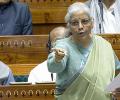
Finance Minister Nirmala Sitharaman launched a strong attack on Rahul Gandhi and the Congress party, accusing them of compromising India's interests on the world stage and selling out farmers and the poor during their time in power.

Persisting uncertainties related to the US trade policies pose downside risk to the overall demand in the Indian economy while the inflation outlook for the near term has become more benign than anticipated earlier, RBI said in its latest bulletin on Thursday. In the August bulletin, the Reserve Bank of India (RBI) also said that India's sovereign rating upgrade by S&P bodes well for capital inflows and sovereign yields, going forward.

The 50 per cent US tariff on Indian goods pose a downside risk to growth but the impact is expected to be short-lived for the economy, and consumption demand could see an uptick after the new goods and service tax (GST) rates are implemented which could even offset the external uncertainty, Chief Economic Advisor (CEA) V Anantha Nageswaran reckoned on Friday.

Equity benchmark indices Sensex and Nifty fell on Friday, extending their downward journey to the third day, as investors continued to reel under pressure caused by the imposition of high tariffs and relentless foreign fund outflows.

Finance Minister Nirmala Sitharaman's biggest challenge will be to find a new growth driver, particularly against the backdrop of a global economy ravaged by heightened uncertainty and fragmentation, financial markets on a precipice, and global commodity prices on a continued uptrend.

Foreign portfolio investors have started 2026 on a cautious note, extending their selling streak from last year by withdrawing Rs 7,608 crore ($846 million) from Indian equities in the first two trading sessions of January. The withdrawal of funds followed the largest outflow of Rs 1.66 lakh crore ($18.9 billion) recorded in 2025, triggered by volatile currency movements, global trade tensions and concerns over potential US tariffs, and stretched market valuations.

Indian equities declined on Friday, with the benchmark Nifty posting its worst weekly fall since September, as foreign investor sentiment remained weak amid tepid earnings growth and little progress on the India-US trade front.
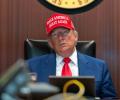
China defended the BRICS economic alliance, stating it is not a bloc for confrontation, after former US President Donald Trump threatened tariffs on countries aligning with its 'anti-American policies'.

India will take all necessary steps to safeguard and promote national interest, Commerce and Industry Minister Piyush Goyal said on Thursday, a day after US President Donald Trump announced 25 per cent tariffs plus penalty on domestic exports to America from August 1.
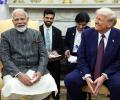
The lawmakers slammed opposition leaders over their remarks on the development, alleging that they were "happy" with the US government's move when "everyone" should be standing together in such a situation.

From the Sensex firms, Bharti Airtel, Tata Motors, Mahindra & Mahindra, Kotak Mahindra Bank, Axis Bank and Reliance Industries were among the laggards. However, NTPC, Titan, Trent, ITC and Bajaj Finserv were the gainers.

India, the world's fourth largest economy, is set to maintain the 'goldilocks' phase with tailwinds of good growth, low inflation and robust banking performance as well as reform initiatives poised to sustain the economic pace witnessed during 2025.

'No, India and China were not about to go to all-out war over a few rocks of Galwan.' 'The full picture of what went on at the highest level between two heads of State will not be known for a very, very long time and rightly so,' points out Colonel Anil A Athale, former head of the history division, ministry of defence.

The Indian economy is growing at a robust pace, driven by strong domestic demand, low inflation, and the healthy balance sheets of banks, said a Reserve Bank report released on Wednesday.

The comments came a day after US President Donald Trump said that Washington is "very close" to the trade pact with India.
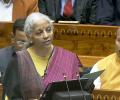
Budget 2026 sticks to fiscal discipline, shuns populist measures despite five key state elections coming up, but ends up rattling stock markets with a higher transaction tax on derivatives trading.

If pharmaceutical exports from India to the US come under a 25 per cent tariff bracket, the impact on earnings before interest, tax, depreciation and amortisation (Ebitda) could be around 5 per cent, felt analysts. This is after assuming that about 75 per cent of the tariff would be passed on.
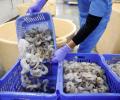
India's shrimp sector was pushed into uncertainty following US President Donald Trump's decision to impose a 25 per cent tariff on all goods imported into the US from India.
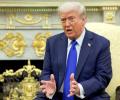
The US Representative criticised the administration's new USD 100,000 fee on H-1B visas, observing that Indians hold 70 per cent of these visas and saying the change directly harms workers who have long supported US innovation across technology, science and medicine.
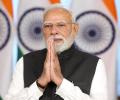
Prime Minister Narendra Modi is likely to address the UN General Assembly in September. The session will address global conflicts and trade negotiations between the US and India.
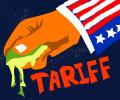
US President Donald Trump on Wednesday slapped an additional 25 per cent tariff on goods coming from India as penalty for New Delhi's continued buying of Russian oil.

Sustaining 8 per cent-plus growth rates is necessary if we are to reach high-income status by 2047, points out Amitabh Kant.

In their talks, Modi and Merz are likely to deliberate on trade and investment ties as New Delhi is looking at deepening economic engagement with Europe against the backdrop of Washington's 50 percent tariff on Indian goods, people familiar with the matter said.

The Budget reflects a clear focus on strengthening India's long-term prospects by leaning on nation-building sectors such as infrastructure, manufacturing, and technology while maintaining fiscal responsibility.
India is hopeful of resuming negotiations on the proposed bilateral trade agreement (BTA) with the US soon and addressing the issue of high tariffs imposed by Washington on Indian goods will be key to striking the deal, a government official said on Thursday.

'We believe the truth is in the middle, and that India is at an important crossroads.'

8 Member of Parliaments were suspended from Lok Sabha for tearing & throwing papers at the Chair till April 2. Uproar started when Rahul Gandhi was barred from citing former Army Chief, General M M Naravane's memoir on 2020 India-China clash. Rediff.com brings you the details of these MPs who were suspended.
India and the US have concluded the fifth round of talks for the proposed bilateral trade agreement (BTA) in Washington. Both sides are looking at finalising an interim trade deal before August 1. Issues related to agriculture and automobiles figured during the negotiations.

The defence minister also announced that India has taken up the challenge of developing a powerful indigenous aero-engine, adding that preparations for this critical project are now almost complete and the work will soon be visible.
India's exports to the US contracted 8.6 per cent to $6.3 billion in October, while imports rose 13.9 per cent to $4.5 billion leading to a trade surplus of $1.8 billion during the month.
 © 2026 Rediff.com - Advertise with us - Disclaimer - Privacy Policy - Sitemap - Feedback - About us - Terms of use - Grievances